Online Sales Conversion Rate: How to Increase It

Anúncios
Online sales conversion rate measures the percentage of visitors who take a desired action, and improving it involves site optimization, traffic quality and effective marketing strategies.
Increasing your online sales conversion rate is a challenge many entrepreneurs face. Have you ever stopped to think about how small tweaks can make all the difference in your sales? In this article, we’ll explore strategies and practical tips that can help you get better results.
Anúncios
What is online sales conversion rate?
Your online sales conversion rate is an essential indicator for any digital business. It measures the percentage of visitors who take a desired action, such as making a purchase or signing up. Understanding this concept is vital to the growth and success of online stores.
How to calculate conversion rate
Calculating your conversion rate is simple. You can use the following formula:
Anúncios
Conversion Rate = (Number of conversions / Total number of visitors) × 100
This means that if you have 100 visitors on your site and 5 of them make a purchase, your conversion rate is 5%. That number may seem small, but it has a big impact on your business’s profitability.
Why conversion rate matters
Your conversion rate is important because it not only shows how effective your site is at turning visitors into customers but also points to areas that need improvement. If your rate is low, it’s a sign that changes are needed.
- Optimizing product pages.
- Improving the user experience.
- Adjusting marketing campaigns.
Understanding and improving your conversion rate should be a priority for any online entrepreneur. The focus should be on understanding user behavior and making the necessary changes so more visitors become real customers.
By adopting strategies to increase your conversion rate, you can maximize your site’s sales potential. These strategies include ad optimization, A/B testing and analyzing customer feedback.
Factors that influence conversion rate
The factors that influence conversion rate are many and vary depending on the type of business and target audience. Understanding these factors is essential for improving your online sales performance.
Traffic quality
The quality of the traffic reaching your site directly affects your conversion rate. If visitors aren’t genuinely interested in your offer, your chances of converting them drop. It’s important to use targeted marketing strategies to attract the right audience.
User experience
Your user experience plays a crucial role in your conversion rate. If your site is slow, hard to navigate or not mobile-responsive, visitors may give up before completing a purchase. Improving the interface and ensuring a user-friendly design can increase conversions.
- Reduce page load times.
- Make sure the checkout process is simple.
- Add high-quality product images.
Customer trust is another important factor. If users don’t feel safe making a purchase, they’re unlikely to complete the transaction. Using security badges and customer testimonials can help build that trust.
Marketing strategies
Finally, the marketing strategies you use have a big impact on your conversion rate. Well-targeted campaigns, special offers and promotions can attract visitors and encourage them to complete their purchase. Running A/B tests to find the most effective approach is a good practice.
Tips to improve your conversion rate
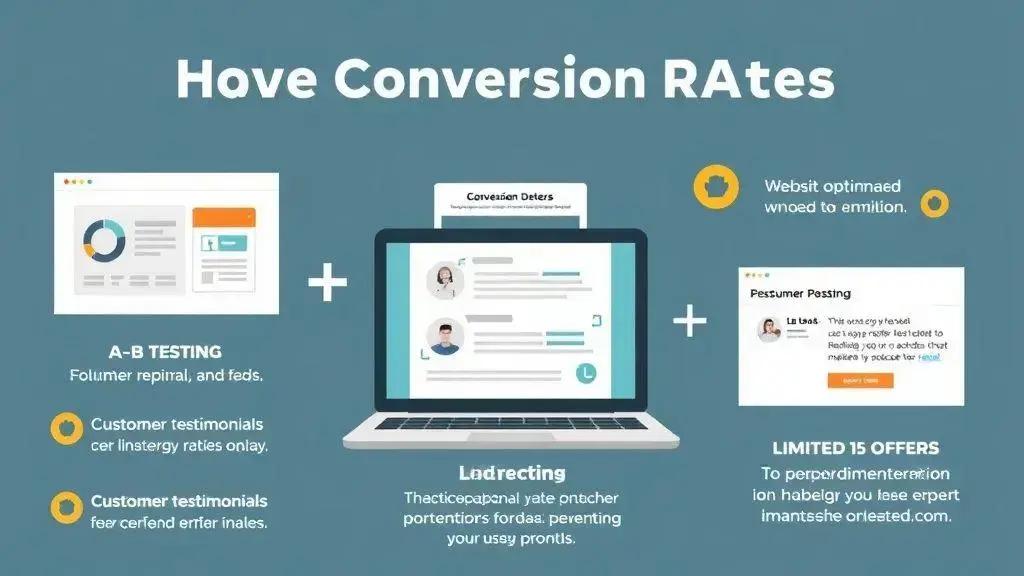
Improving your conversion rate is essential to your online business’s success. There are several strategies you can use to make your site more effective and maximize sales. Here are some valuable tips.
Site optimization
The first tip is to make sure your site is intuitive and easy to navigate. Reducing the number of steps in the buying process can make a big difference. The simpler the experience, the more likely visitors are to complete their purchase.
A/B testing
Running A/B tests can help you discover what works best with your audience. Test different versions of product pages, call-to-action buttons and even colors to find out what generates the most conversions.
- Test different page layouts.
- Try out various calls to action.
- Compare product images and descriptions.
Clear communication is another important tip. Use copy that’s direct and focused on the product’s benefits. Make sure visitors quickly understand what they’re buying and how it will benefit them.
Customer testimonials
Including customer testimonials or product reviews can increase new visitors’ trust. When they see that other people are happy with their purchase, it can encourage them to buy the product.
Another strategy is to use limited-time offers. Time-limited promotions, like free shipping or temporary discounts, are great for creating a sense of urgency. This can motivate users to act quickly and complete their purchase.
How do you measure conversion rate effectively?
Measuring your conversion rate effectively is crucial for understanding your site’s performance. This metric shows how many visitors became customers, and analyzing it regularly helps you identify areas for improvement.
Analytics tools
Using web analytics tools can make it easier to track your conversion rate. Platforms like Google Analytics offer detailed reports, letting you measure the performance of specific pages and marketing campaigns. Set up goal tracking to see conversions in real time.
Setting clear goals
It’s important to set clear goals for what you consider a conversion. This can include not only sales but also lead capture, content downloads or newsletter sign-ups. The more specific you are, the better you can measure success.
- Define what counts as a conversion.
- Use events and remarketing to track user behavior.
- Compare different periods to analyze growth or decline in your conversion rate.
Breaking down your data by acquisition channel can also help you understand which strategies are working. By analyzing your conversion rate by channel, such as social media, email marketing and organic traffic, you can see where to put more focus.
Interpreting the data
Interpreting the data carefully is essential. A low conversion rate isn’t necessarily bad if you understand the customer journey. Sometimes more qualified traffic can have a better conversion rate, even if the total number of visitors is lower.
Finally, regularly tracking and analyzing all this data should be a constant part of your strategy. This will allow for continuous adjustments and more effective improvements.
Case studies on increasing conversion rates
The case studies on boosting conversion rates below are an excellent way to understand how different strategies can affect an online business’s success. Analyzing practical examples helps identify what works and what doesn’t in the real world.
Example 1: Online clothing store
An online clothing store noticed that its conversion rate had stalled. After a review, they found that the checkout process was too complex, leading customers to abandon their carts. By simplifying checkout and offering a variety of payment options, they increased their conversion rate by 30% in three months.
Example 2: Online education platform
An online education platform had low sign-up rates. They implemented a remarketing strategy, sending personalized emails to visitors who didn’t complete their sign-up. After this change, they saw a 25% increase in their conversion rate. This shows how important it is to keep engaging customers after their first visit.
- Using student testimonials.
- Free trials for new users.
- User interface improvements to simplify the sign-up process.
These cases show that small changes can have a big impact. Companies that invested time in analyzing data and understanding user behavior were able to identify problems and implement effective solutions.
Example 3: SaaS software company
A software-as-a-service (SaaS) company was struggling to convert visitors into subscribers. They decided to create a more focused landing page, centered on a single service with a simple sign-up form. The result was a 40% increase in their conversion rate in just two months, highlighting the importance of having a clear goal on your landing pages.
Understanding and improving your online sales conversion rate is essential for any digital business. By analyzing the factors that influence this rate, you can identify growth opportunities and implement effective strategies. Case studies show how small changes can lead to big increases in conversions. Use the tips above to optimize your approach and take advantage of the tools available to measure your progress. With attention and effort, you can turn visitors into loyal customers.
FAQ – Frequently asked questions about online sales conversion rate
Why is conversion rate important for my business?
Conversion rate is crucial because it shows how effective your site is at turning visitors into customers, directly affecting your sales.
How can I improve my site’s conversion rate?
You can improve your conversion rate by simplifying the checkout process, optimizing the user experience and implementing effective marketing strategies.
What tools can I use to measure conversion rate?
Tools like Google Analytics and Hotjar are excellent for measuring conversion rate and understanding how users interact with your site.
What can I learn from conversion rate case studies?
Case studies offer practical insights into successful strategies, letting you apply tactics that worked for other companies to your own business.