Dropshipping: Scale to $10,000 a Month in 120 Days

Anúncios
How to Scale Your Dropshipping Business to $10,000 a Month in 120 Days
Dropshipping has established itself as one of the most accessible and profitable ways to start an online business. The promise of selling products without holding physical inventory attracts entrepreneurs of every level. However, the real challenge isn’t just getting started, but learning how to **scale dropshipping** to reach meaningful, sustainable revenue. Many dream of hitting $10,000 a month, but few know how to map out an effective plan to get there in a relatively short time, such as 120 days.
Anúncios
This complete guide was created to demystify the scaling process in dropshipping, offering a detailed roadmap and proven strategies to help you transform your business and reach $10,000 a month. We’ll cover everything from the right mindset to marketing and optimization tactics, all grounded in the realities of running a dropshipping store today.
The Mindset of a Successful Dropshipping Entrepreneur
Before we dive into tactics, it’s crucial to get your mindset right. Scaling a dropshipping business in 120 days requires discipline, resilience, and a strategic approach. It’s not an easy path, and there will be challenges. The key is to see them as opportunities to learn and adjust.
Anúncios
Set Clear, Measurable Goals
Your goal is $10,000 a month by day 120. Break that goal down into smaller weekly and daily targets. How much do you need to sell per day? What is your average order value? How many sales do you need to hit that number?
Example calculation:
- Monthly goal: $10,000
- Weekly goal (average): $2,500
- Daily goal (average): $333
- Average order value: $50
With a $50 average order value, you’ll need about 7 sales per day, or roughly 200 sales per month. Broken down like that, it feels much more achievable, right? This clarity is essential to **scale dropshipping** efficiently.
Focus on Continuous Optimization
Dropshipping is an optimization game. Test products, test creatives, test audiences, test offers. What works today may not work tomorrow. Always be willing to analyze data, make adjustments, and improve your processes. The relentless pursuit of improvement is what separates stagnant businesses from those growing exponentially.
Phase 1: Preparation and Validation (Days 1-30)
The first 30 days are crucial for laying a solid foundation for your business and validating your ideas. Don’t skip steps in this phase, as it will determine the speed and sustainability of your growth.
1. Researching a Profitable Niche and Product
To **scale dropshipping**, product choice is perhaps the single most important factor. It’s not enough to pick a ‘cool’ product; it needs to have demand, solve a problem, and offer a good profit margin. Products that appeal to emotion, convenience, health, or wellness, or that are novel and hard to find in physical stores, tend to perform well.
- Research Tools: Use platforms like AliExpress and Amazon (to understand trends), Google Trends, the Facebook Ads Library (to see what competitors are advertising), and paid tools such as Niche Scraper or Ecomhunt.
- Selection Criteria:
- High demand, low competition (ideal, but difficult).
- A profit margin of at least 100% (to cover marketing and operating costs).
- A product with a ‘wow factor’ or one that solves a specific problem.
- Easy to explain and demonstrate in short videos.
- Avoid products that are very large, heavy, or fragile due to shipping costs and risks.
- Product Testing: Instead of investing heavily in a single product, start with small tests. Create ads for different products and see which one generates the most interest and clicks at a low cost.
2. Choosing and Optimizing Your E-commerce Platform
Shopify is the platform of choice for most dropshippers thanks to its ease of use and app integrations. However, other options such as WooCommerce (for WordPress) or BigCommerce are also viable, especially if you’re already familiar with them.
- Professional Design: Your store should be clean, fast, and mobile-responsive. Invest in a quality theme.
- Product Page Optimization:
- High-Quality Images and Videos: Show the product in use, along with its benefits and differentiators.
- Persuasive Descriptions: Focus on the benefits and the solution the product offers, not just its features. Use persuasion triggers.
- Social Proof: Add customer reviews and testimonials.
- Clear Calls to Action (CTAs): ‘Buy Now’, ‘Add to Cart’.
- Shipping and Delivery Information: Be transparent about delivery times, which can be longer in dropshipping.
3. Selecting Reliable Suppliers
Supplier quality directly affects customer satisfaction and your business’s reputation. AliExpress is the most common starting point, but also consider local suppliers or sourcing agents for faster delivery times.
- Selection Criteria: Good reviews, a track record of fast shipping, good communication, and consistent product quality.
- Automation Tools: Use DSers or similar tools to automate product imports and order processing.
- Communication: Maintain clear, consistent communication with your suppliers to avoid problems.
Phase 2: Launch and First Sales (Days 31-60)
With your structure in place, it’s time to drive traffic and start generating sales. In this phase, the focus is on validating your offer and your marketing.
1. Digital Marketing Strategies
To **scale dropshipping**, you’ll need to master paid advertising platforms. Facebook Ads and Instagram Ads are the most effective for dropshipping, but Google Ads and TikTok Ads are also worth exploring.
- Facebook/Instagram Ads:
- Target Audience: Start with broad audiences and refine based on data. Use interests, behaviors, and lookalike audiences.
- Persuasive Creatives: Short, engaging videos that show the product in action and solve a problem. Use clear captions and calls to action. Test different angles and approaches.
- Testing Budget: Start with a low daily budget ($5-$15) to test multiple creatives and audiences.
- Retargeting Campaigns: Essential for converting visitors who didn’t buy on their first visit. Offer a small discount or free shipping.
- Google Ads (Shopping and Search): For products with existing demand, Google Shopping can be very effective. Google Search is good for bottom-of-funnel keywords.
- TikTok Ads: Growing fast and ideal for viral products and younger audiences.
2. Conversion Rate Optimization (CRO)
Attracting traffic isn’t enough; you need to turn that traffic into sales. Monitor your conversion rates and identify points of friction.
- A/B Testing: Experiment with different headlines, descriptions, images, CTAs, and even page layouts.
- Abandoned Carts: Set up email or SMS/WhatsApp sequences to recover abandoned carts. Offer an incentive.
- Page Speed: Optimize your store’s loading speed. Slow pages drive customers away.
- Checkout Process: Simplify checkout as much as possible. Fewer steps, more sales.
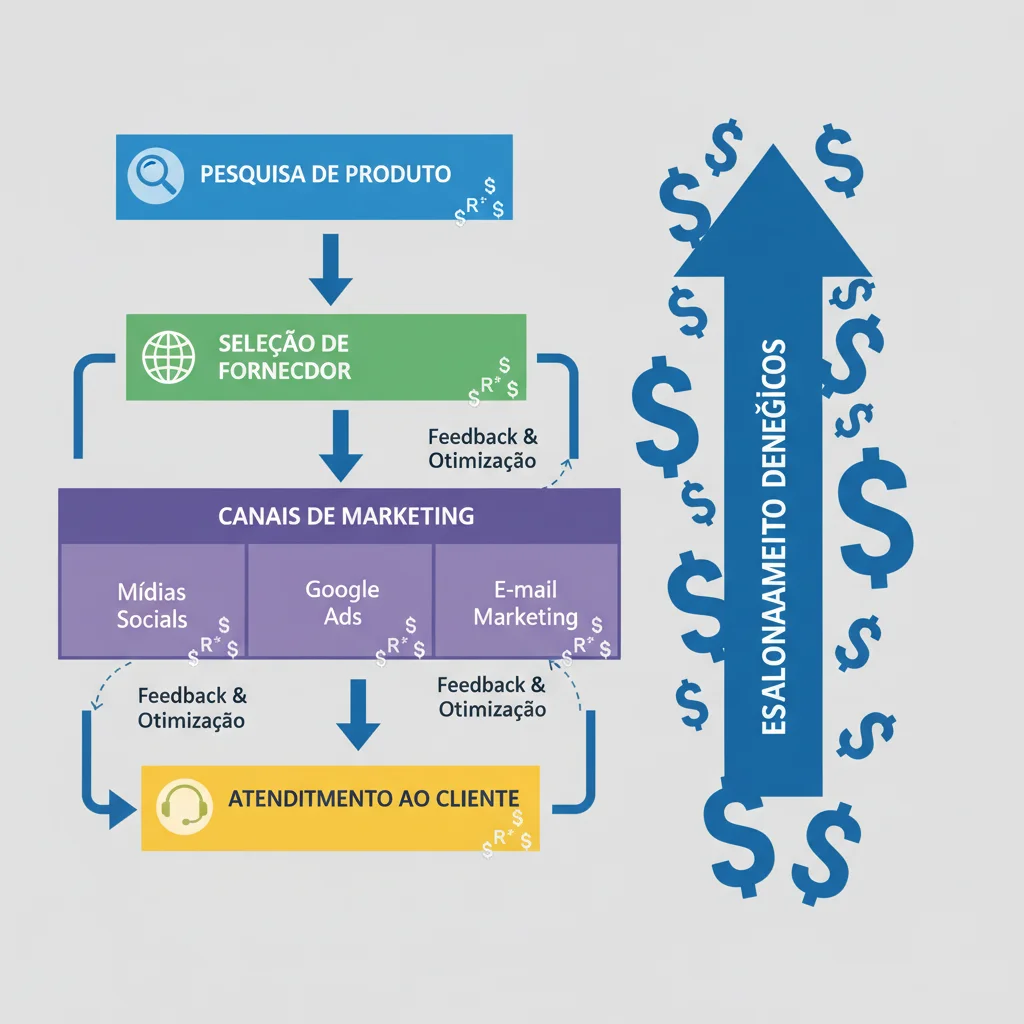
Phase 3: Scaling and Optimizing Profits (Days 61-90)
After your first sales and validation, the focus shifts to scaling. This is where you start increasing your marketing spend and optimizing your processes to maximize profit.
1. Data and Metrics Analysis
To **scale dropshipping**, you need to be obsessed with data. Constantly monitor metrics such as:
- Cost per Acquisition (CPA): How much you spend to acquire a customer.
- Customer Lifetime Value (LTV): How much a customer spends with you over time.
- Return on Ad Spend (ROAS): How much you earn for every dollar spent on ads.
- Conversion Rate: The percentage of visitors who become customers.
- Profit Margin: Check that your products are still profitable after all costs.
Use Google Analytics and your ad platforms’ dashboards to track these numbers. Identify what’s working and what needs adjusting.
2. Ad Scaling Strategies
Once you find a winning product and a creative that converts, it’s time to scale. There are several ways to do this:
- Vertical Scaling (Budget): Increase the daily budget of your winning campaigns. Do it gradually (10-20% per day) so you don’t destabilize the algorithm.
- Horizontal Scaling (Audiences): Expand into new lookalike audiences or related interests. Test different combinations.
- Creative Scaling: Create variations of your best-performing creatives. Change the music, the video’s opening, or the call to action.
- Test New Platforms: If you’re succeeding on Facebook, consider expanding to Google Ads, TikTok Ads, or Pinterest Ads.
3. Supply Chain and Logistics Optimization
As sales grow, logistics become more critical. Long delivery times or supplier problems can hurt the customer experience.
- Multiple Suppliers: Always have a backup supplier for the same product.
- Sourcing Agents: Consider working with a sourcing agent who can consolidate orders and offer better delivery times and prices.
- Order Tracking: Provide a clear, easy-to-use tracking system for your customers.
- Proactive Communication: Keep customers informed about their order status, especially in case of delays.
4. Excellent Customer Support
Good customer support is essential for retention and for your business’s reputation. Friendly, human service makes all the difference.
- Support Channels: Offer multiple channels (WhatsApp, email, live chat).
- Fast Responses: Aim to answer customer questions and issues as quickly as possible.
- Clear Policies: Have well-defined, easy-to-find exchange, return, and refund policies.
Phase 4: Consolidation and Expansion (Days 91-120)
In this final phase of your 120-day plan, the goal is to lock in $10,000 in monthly revenue, optimize profitability, and plan for future expansion.
1. Customer Loyalty and Increasing LTV
Acquiring new customers is important, but keeping existing ones is more profitable. To **scale dropshipping** sustainably, invest in loyalty.
- Email Marketing: Create email sequences to nurture leads, offer exclusive promotions to past customers, and announce new products.
- Loyalty Programs: Offer discounts or points to customers who buy regularly.
- Upsells and Cross-sells: Offer complementary products or premium versions at checkout or in email campaigns.
- An Excellent Post-Purchase Experience: Ask for feedback, solve problems quickly, and delight your customers with great service.
2. Diversifying Products and Niches
Don’t put all your eggs in one basket. As you reach your goal, start exploring new products or even new niches. This reduces risk and opens new revenue streams.
- Trend Analysis: Keep an eye on emerging consumer trends.
- Catalog Expansion: Add products that complement your best-sellers.
- Controlled Tests: When testing new products, start with small budgets, just as you did at the beginning.
3. Automating and Delegating Tasks
To truly **scale dropshipping**, you can’t do everything yourself. Automate as much as possible and, if your budget allows, start delegating.
- Marketing Automation: Use tools for email marketing, chatbots, and social media scheduling.
- Order Automation: Make sure forwarding orders to your supplier is as automated as possible.
- Virtual Assistant: Consider hiring a virtual assistant for customer support, product research, or social media management.

Common Dropshipping Challenges and How to Overcome Them
Every market has its quirks. Being aware of the challenges and knowing how to work around them is essential to **scale dropshipping**.
1. Long Delivery Times
Customers are used to fast deliveries. Delivery windows of 15-45 days can be a problem.
- Solution: Be transparent about delivery times in the product description, on the checkout page, and in your store policies. Offer detailed tracking. Where possible, use suppliers with faster shipping options or local warehouses for specific products.
2. Incomplete Payments and Pending Orders
Some payment methods (such as bank transfers, vouchers, or buy-now-pay-later flows) generate many orders that are never completed.
- Solution: Set up payment reminders (email, SMS, WhatsApp). Offer a small discount for instant payment methods such as cards or digital wallets. Use payment gateways that integrate well with these options.
3. Consumer Distrust
Because of negative experiences with online scams, some consumers can be wary of unfamiliar stores.
- Solution: Invest in social proof (testimonials, reviews). Run a professional, transparent store. Offer good customer support and clear exchange/return policies. Use trust badges and SSL certificates.
4. Currency Fluctuations and Taxes
Exchange rate swings and import duties can impact your margins.
- Solution: Build a cushion into your margins to account for possible fluctuations. Stay up to date on import rules and taxes in the countries you sell to. Track costs in a single base currency in your spreadsheet for a clearer picture.
Essential Tools to Scale Your Dropshipping Business
To **scale dropshipping**, you’ll need an arsenal of tools that save time and improve results:
- E-commerce Platform: Shopify (most complete), WooCommerce, BigCommerce.
- Suppliers: AliExpress, DSers (AliExpress automation), CJDropshipping (for more integrated suppliers).
- Marketing: Facebook Ads Manager, Google Ads, TikTok Ads, Mailchimp or ActiveCampaign (email marketing), ManyChat (chatbot).
- Data Analysis: Google Analytics, Hotjar (heatmaps), ad platform reports.
- Customer Support: WhatsApp Business, Zendesk, LiveChat.
- Creatives: Canva, CapCut (video editing), InVideo.
Conclusion: The Path to $10,000 in 120 Days Is Real
Reaching $10,000 a month in dropshipping in just 120 days is an ambitious goal, but entirely achievable with the right strategy, dedication, and continuous optimization. This guide has provided a detailed roadmap, from product selection to scaling tactics and overcoming common challenges.
Remember that success doesn’t happen overnight. It requires constant learning, testing, adjusting and, above all, persistence. Focus on building a solid foundation, optimizing your campaigns, delivering excellent customer service and, most importantly, learning to **scale dropshipping** smartly and strategically. Start today, apply these tactics, and watch your business take off!